Half cut

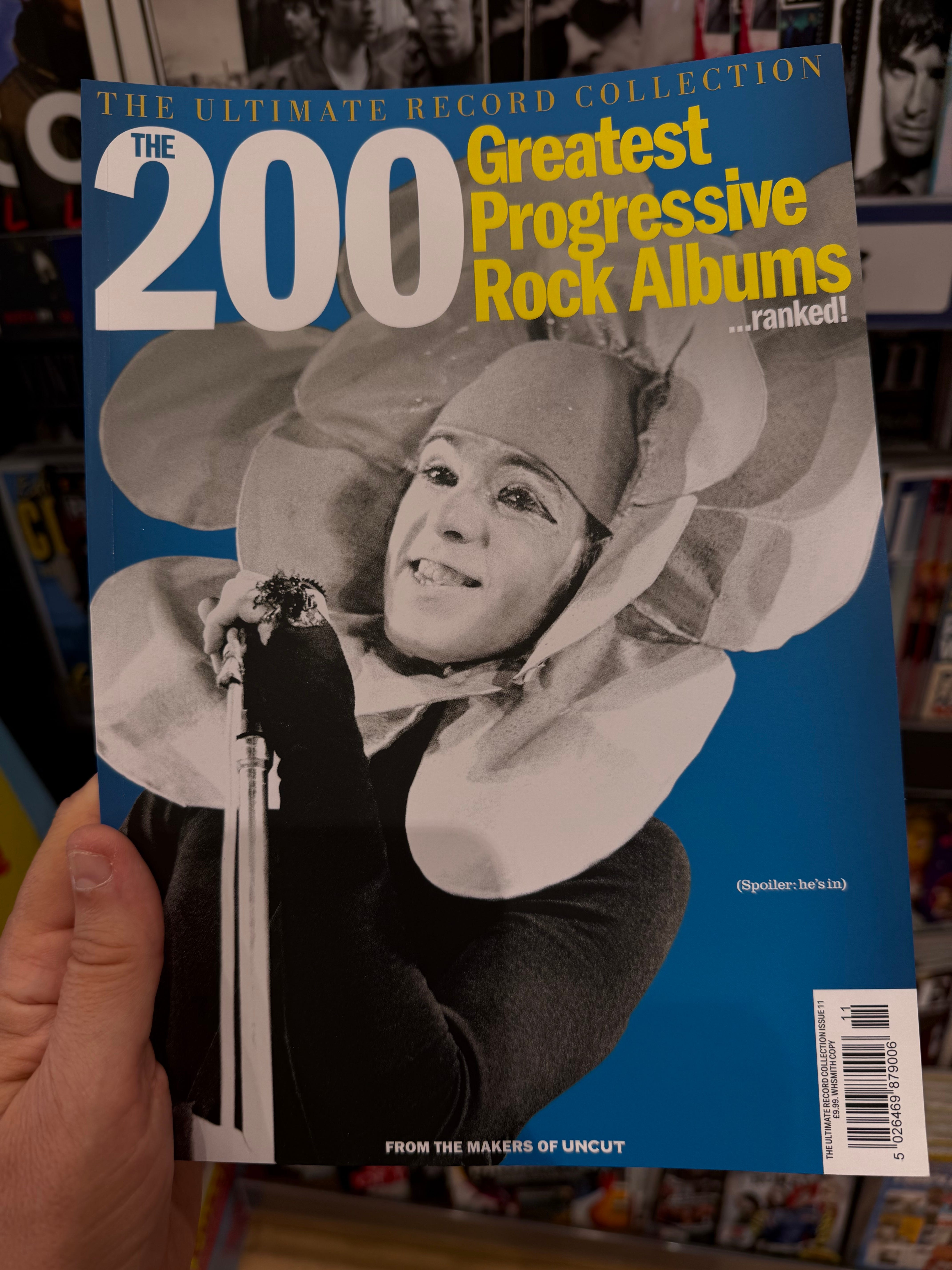
If I’m honest, I picked up this newly published special edition of Uncut magazine both with interest and a degree of self-interest.
Big Big Train has been reviewed a couple of times in Uncut (an excellent and influential mainstream music publication) and, whilst I had no expectation of a high placing in the magazine’s top 200 progressive rock albums, I carried a slight hope that we might make an appearance or two in the lower reaches.
I flicked through the magazine in my local WHSmith’s (a shop that, in appearance, is now more a late-period Woolworths instead of the book-seller and newsagent of old) but found no mention of BBT in the first few pages (where the 200 to 150 chart placings were set out). Fair enough: we’re below the radar for many music writers.
However, I ploughed on through the magazine, no longer focusing on the self-interest angle but wondering how the list would play out, especially when it came to balancing albums released in the 70’s with those released during the early 80’s revival and those from the so-called third wave period (the 90’s through to now).
These lists are, of course, subjective but my assumption was that popular albums by Marillion and perhaps by Steven Wilson would be cheek-by-jowl with 70’s classics. I was intrigued as to how the editorial team would assess the relative merits of the different era bands. And how would the heavier rock fraternity (Rush, Dream Theater et al) be ranked? What about albums that successfully walk the line between alternative and prog rock (Radiohead, Talk Talk)? Howabout slightly more obscure but excellent albums by the 80’s second generation bands such as Twelfth Night (whose Fact and Fiction album has more than stood the test of time), Solstice, Pendragon, IQ and Pallas? Would any later period Pink Floyd recordings make the (un)cut? Many of these questions would surely be answered on the following pages.
But they weren’t because, according to this special edition of Uncut, prog rock only existed in the 70’s.
Well, that statement is not completely true, because two albums from 1980 did sneak in - Duke by Genesis and an avant / Rock In Opposition band from Belgium called Aksak Maboul whose album Un Peu De L’âme Des Bandits was awarded 182nd place on the list. But those two albums are, I think the latest releases mentioned. The other 198 albums are from the 70’s or 60’s.
I tried to think of a parallel scenario with different genres. The closest I could think of would be a best ever list of metal albums (a genre with a similar timeline to prog rock) which excluded Iron Maiden and Metallica. That would be a very strange list indeed.
I’m only too aware that the progressive rock glory days lie firmly back in the 70’s and that the charts will never again see simultaneous top 40 appearances from prog rock artists. Nevertheless, there is so much more to the genre than the extraordinarily narrow definition as deployed by Uncut.
Completely agree. I saw it advertised and pre ordered my copy so as not to miss it. Apart from (possibly not deliberately) of reinforcing a stereotype, to me it was something that could have easily been fixed by adding “of the 1960s and 1970s” as a subtitle. I doubt that would have impacted sales. Even an explanation in the editorial about what the focus was would have at least clarified. I’m not a massive fan of “list” articles / magazines - they always feel a bit like page fillers to me. But these magazines clearly have an audience and they aren’t cheap!
By contrast the next day, my subscriber copy of Prog Magazine arrived and made up for the disappointment. Jerry and the team have consistently delivered a magazine which strikes the right balance between old and new / stuff you’ve heard of and stuff you haven’t. Plus Jerry has always been very open about the challenges of publishing the magazine - for example you can’t just put anyone on the cover! Uncut clearly realise that with the classic era Gabriel photo, and Prog recognise that having Kate Bush on the cover of a magazine most likely to appear on shop shelves in the UK and Europe will draw a crowd (some great articles on her too who is, let’s face it, an artist who would not typically end up in prog rock best album lists).
As for the Uncut one… well there’s plenty of 1970s music in there I’m not familiar with. So I think I’ll gather a playlist of stuff that I don’t know at all and might discover something I wouldn’t have before, and redeem the whole experience.
You may have already done this Greg, or indeed decided not to, but I think you should send this entire piece to the magazine, as a) it’s from a major player in modern prog, b) it’s beautifully and cogently written, and c) it’s not just an ‘aww you forgot about my favourite album’ post, of the kind these sort of lists tend to garner, presumably deliberately